USA Archery Platform Modernization
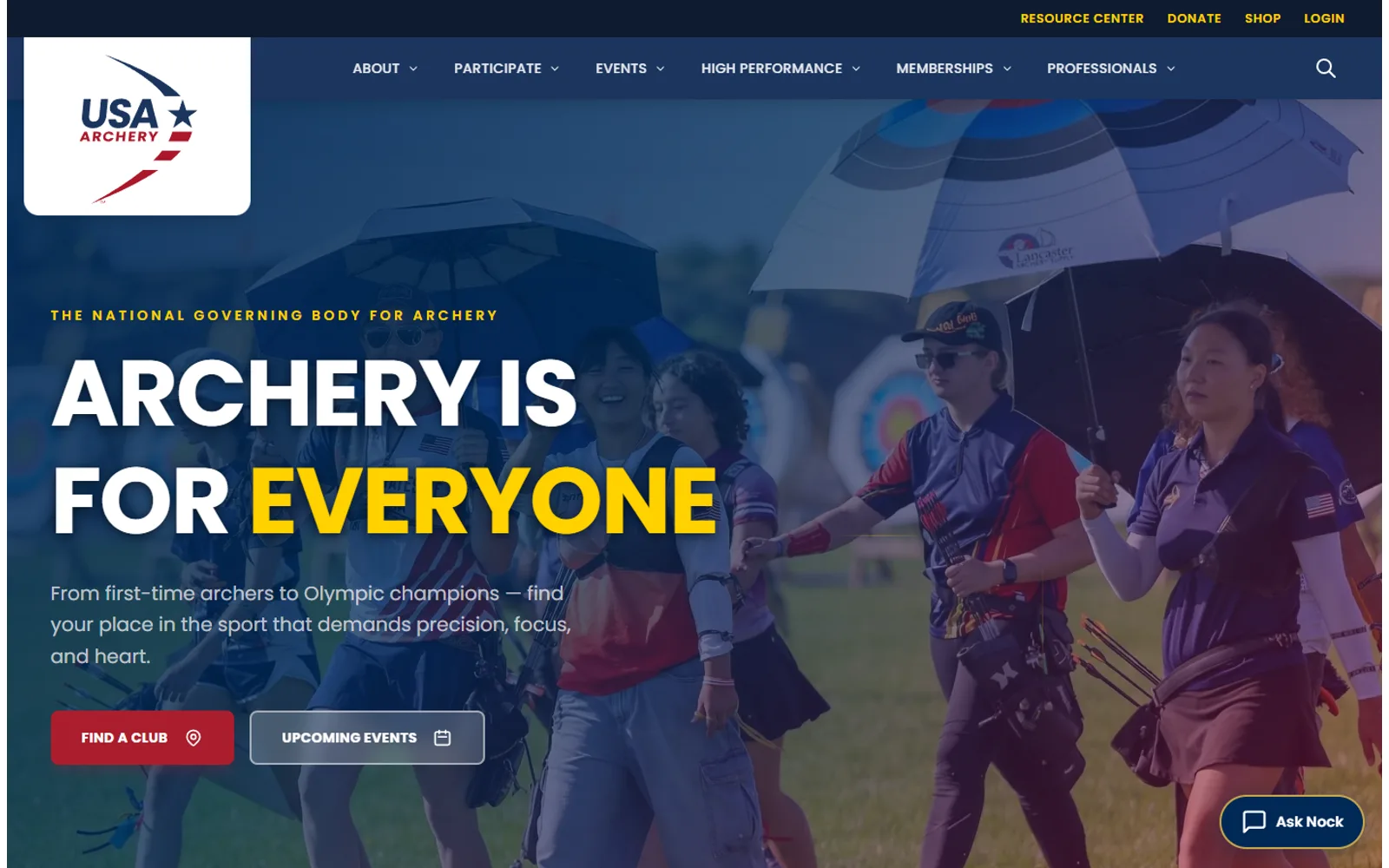
A working modernization of a national governing body's WordPress site — 2,900+ articles migrated to Payload CMS, a rebuilt information architecture, role-based editorial workflow, and a governed AI assistant with citation-backed answers.
- Project
- USA Archery (proposal & working demo)
- Role
- Principal — strategy, IA, and implementation
- Timeline
- 2026
- 2,900+
- Articles migrated
- 739
- Resources catalogued
- ~1-2 min
- Build time, from 6+
A national governing body’s platform, rebuilt
USA Archery carries a lot on one website: Olympic and Paralympic team information, membership, coach and judge certification, event sanctioning, SafeSport compliance, and a large archive of member resources. All of it ran on a WordPress installation that had grown difficult to manage and expensive to maintain.
I built the modernization as a working demo, deployed and explorable, running the organization’s real content.
Organizing around who actually arrives
The legacy site buried everything in deep sidebar navigation, and audiences with completely different goals shared the same paths. A parent checking SafeSport and a coach seeking certification were treated as the same visitor.
I audited the legacy navigation and rebuilt the information architecture around the five people who actually show up: someone who wants to try archery, a member renewing, a coach seeking certification, a parent checking SafeSport, and a fan following the national team. The deep sidebar became a mega menu that shows the full depth in the open, and every page carries a contextual sidebar so visitors can see where they are and what sits alongside it.
I documented the work as artifacts the organization keeps: an information architecture map, decision records for the platform choice and the migration, a design system, and a content-ownership matrix naming exactly which content staff control and which developers do.
Twenty years of content, made findable
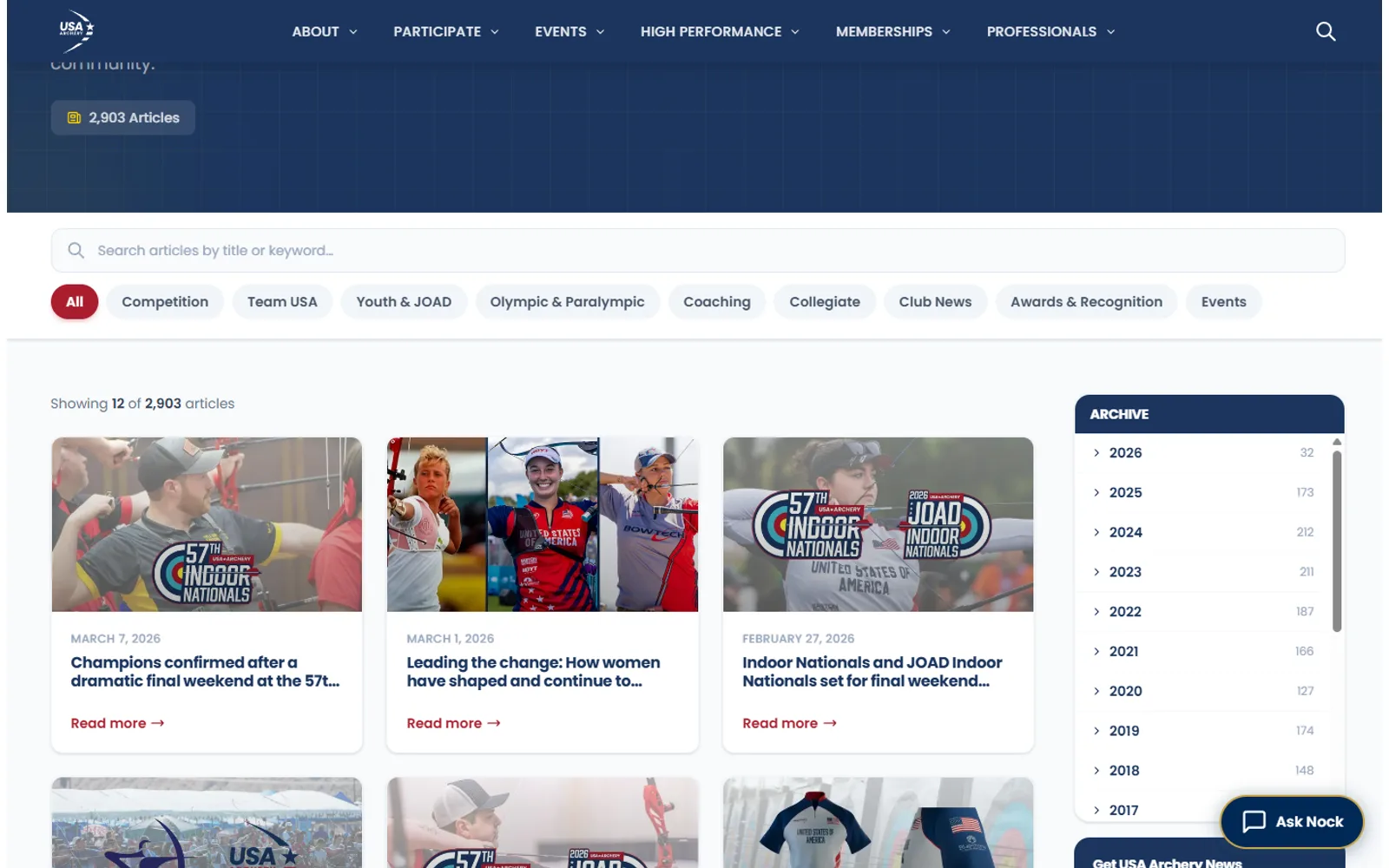
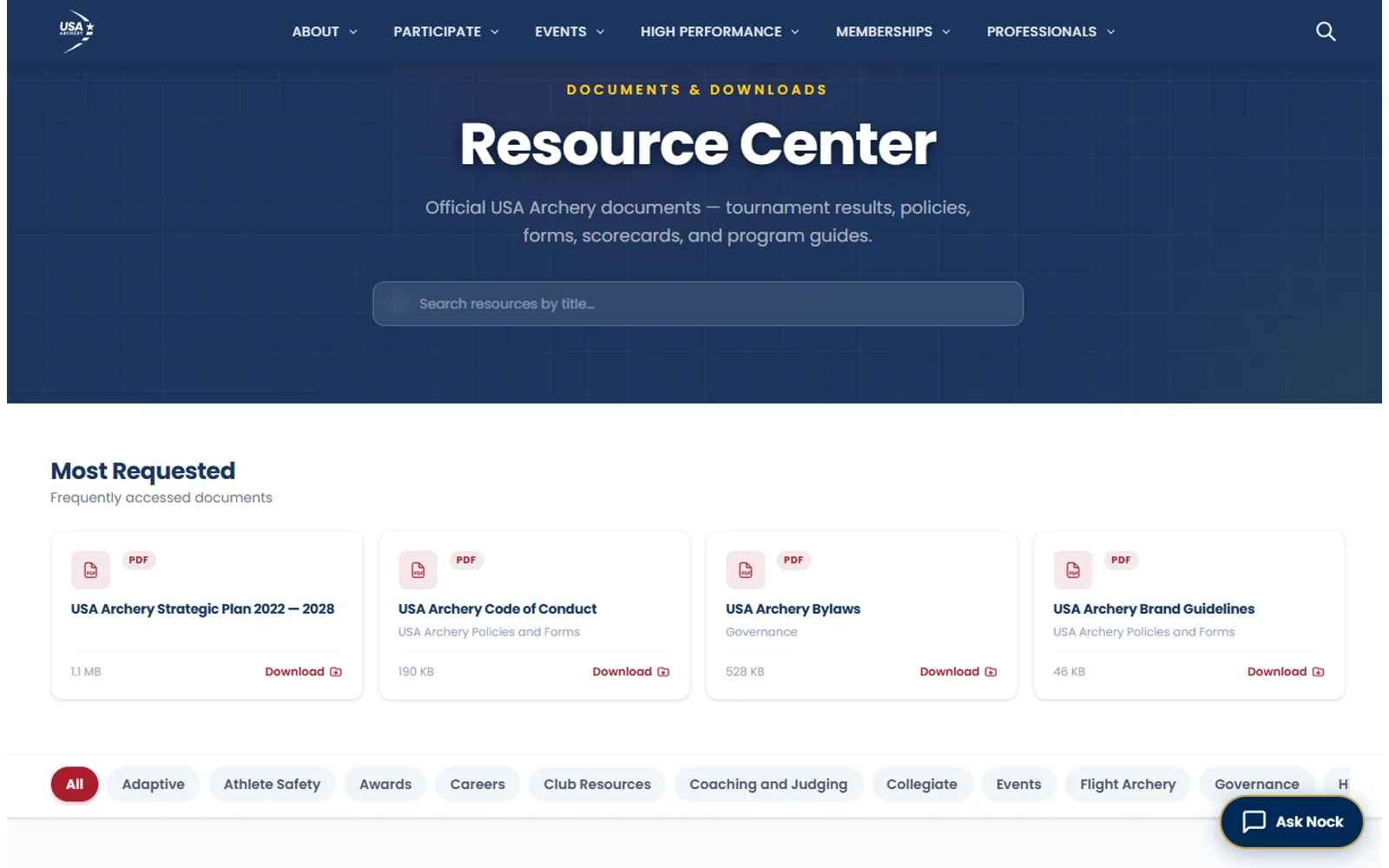
2,900+ articles, 134 pages and 739 downloadable resources moved to the new platform, cleaned up on the way — broken legacy links repaired, thin pages routed to review rather than published, and every resource sorted into one of 21 categories.
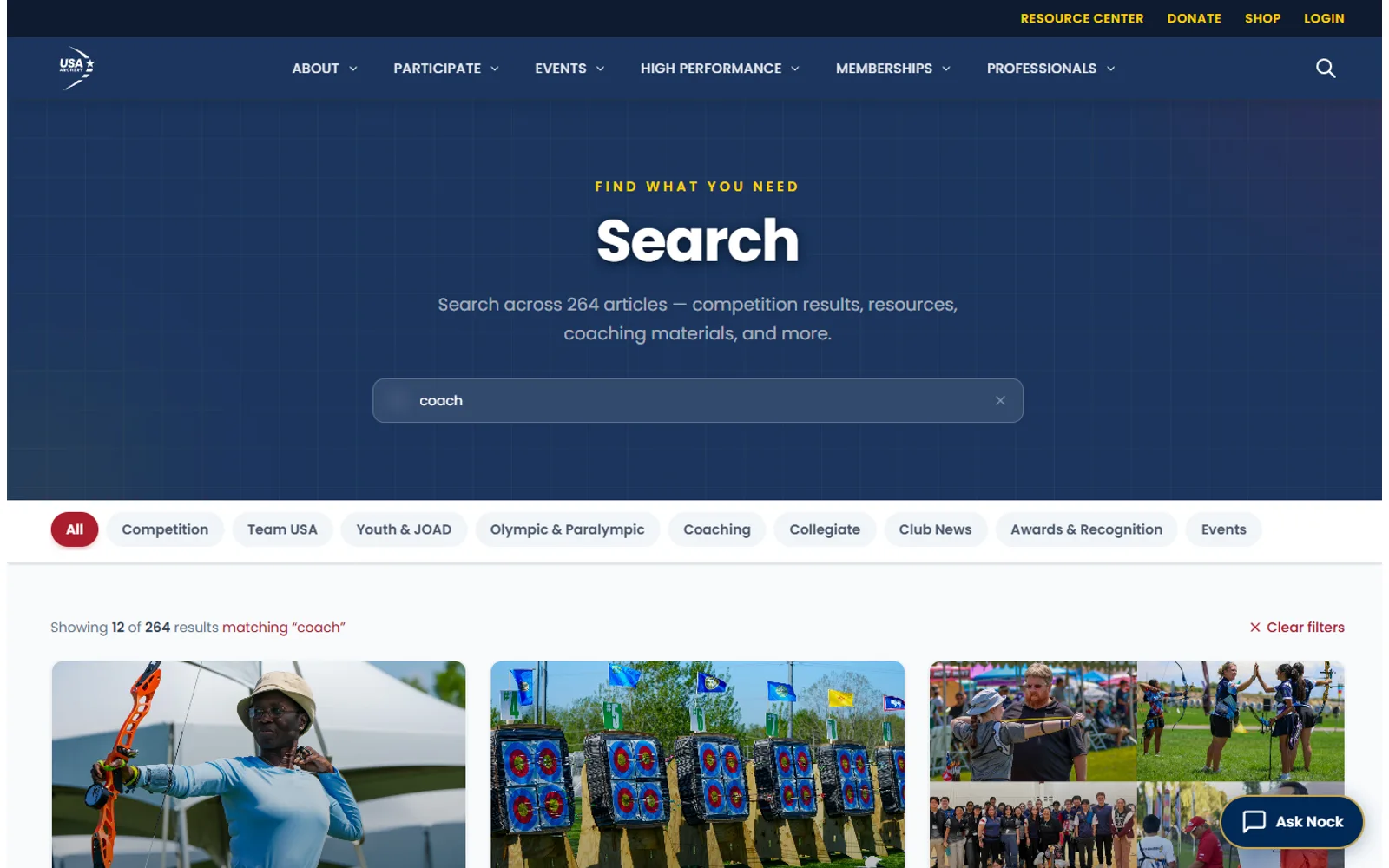
Moving an archive is only worth doing if people can find things in it afterwards. News, resources and site search all share one filtering vocabulary, so a search for “coach” narrows 2,903 articles to 264 and keeps narrowing by category. Visitors can filter 207 national team athletes by division and discipline, and 41 events by state and by competition level.
Nock: KCS reasoning as conversational AI
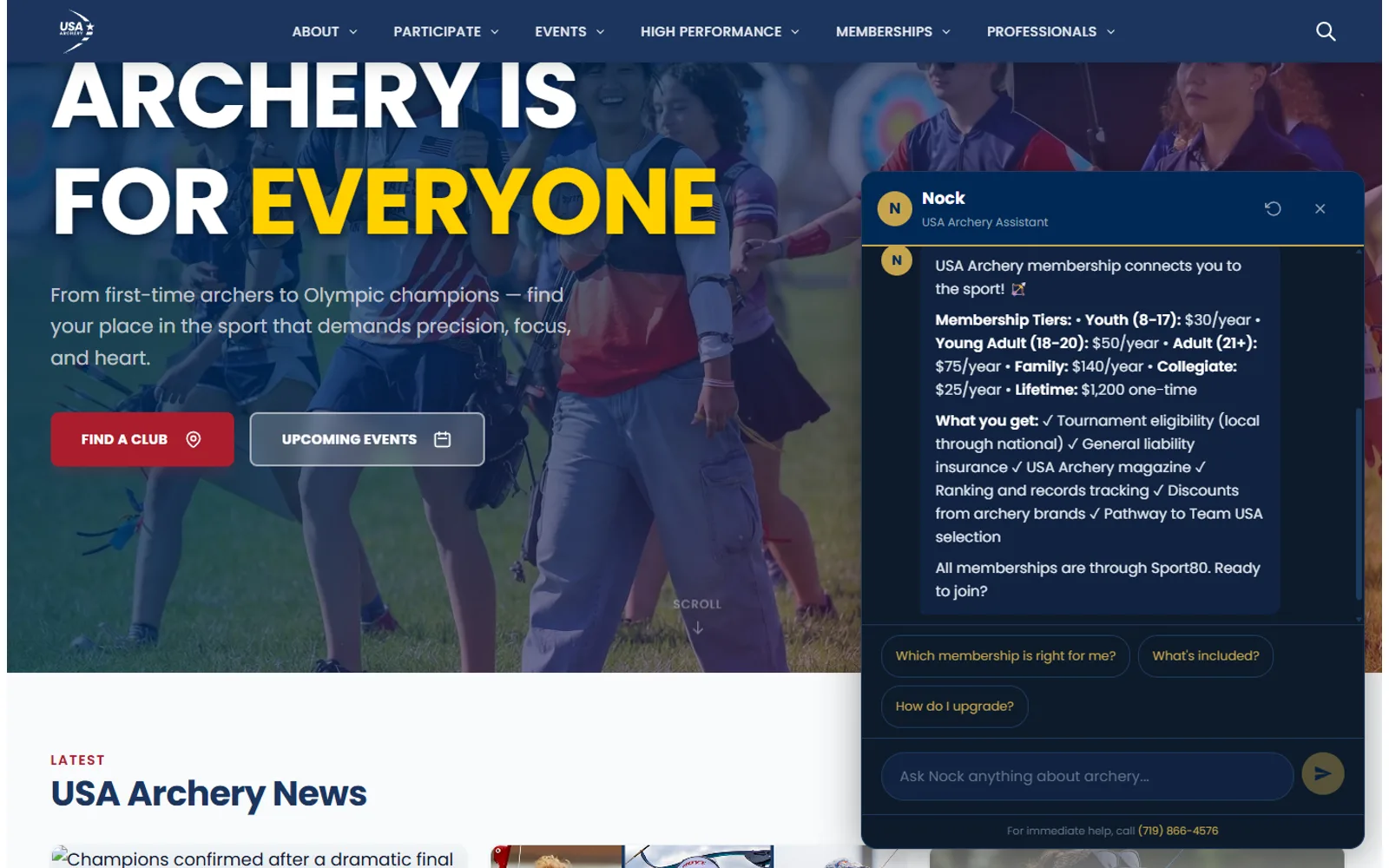
The assistant is named Nock, after the notch on an arrow — the first step before every shot. It answers in three tiers, and the ordering is the design:
- Curated answers. Staff write the answers to the questions they get most, and those come back instantly, worded the way the organization wants.
- Answers from published content. With no curated match, Nock searches the site’s own pages and articles and answers from them, showing which sources it used.
- Model fallback. Reached when the organization’s own content has nothing to offer.
This is KCS structure expressed as conversational AI. Curated answers are the known-good articles; cited retrieval is search against the knowledge base. The organization’s own words come first.
Governance matters as much as retrieval. Nock answers from what USA Archery has published, routes SafeSport questions to the U.S. Center for SafeSport, keeps athlete information private, and says plainly when a question falls outside what it knows. Staff manage the curated answers themselves, and the panel tracks how often each one is used — so the questions that fall through to the model become a measured list of content worth writing.
Built for the way the organization works
Staff publish through the CMS the way they would on any content platform, with no developer involved. The site is tuned for a governing body’s traffic shape, where an Olympic medal can arrive as a sudden spike.
Editorial permissions mirror what the organization already does in WordPress: five roles, with authors drafting and editing their own news and events, editors and above updating anything, and membership records restricted to administrators. Logged-in editors get an edit button on the page itself, linking straight to the record behind it.
Design follows the organization’s published brand guide — Poppins, and the specified Pantone-matched navy and red.
Inside the build
5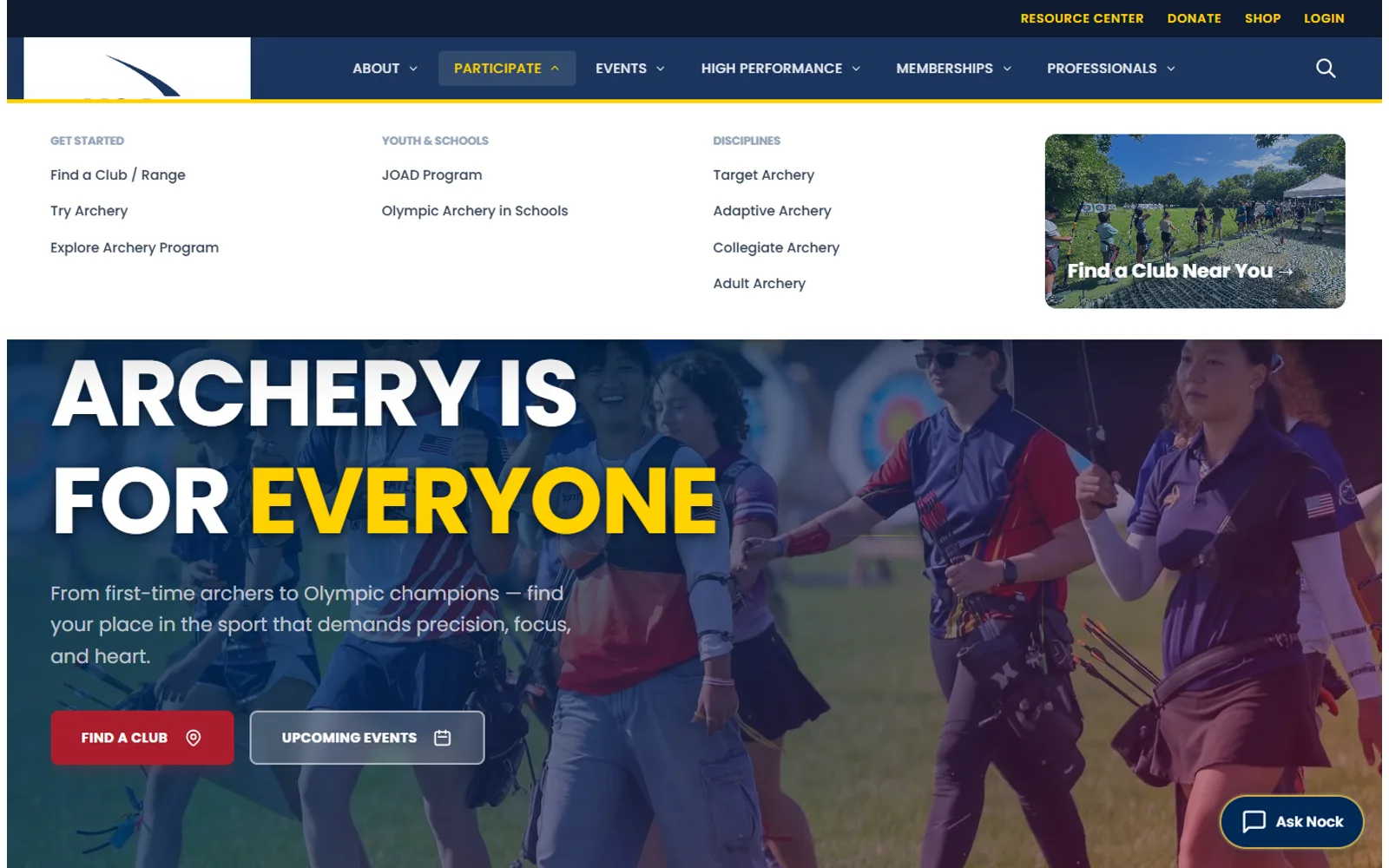
More designed & built work
-
TerraGreetings
TerraGreetings
A subscription platform for printable outdoor-themed greeting cards — built end to end with auth, payments, an admin CMS, and a browser-side duplex PDF print engine.
-
KnowledgePeak.ai
KnowledgePeak.ai
An AI documentation generator that puts enterprise knowledge practice within reach of small teams — guided questionnaires produce structured articles, with provider-agnostic LLM routing and admin-configurable templates.
-
Shimmer (open source)
Shimmer
Open-source audio restoration and mastering software that removes generation artifacts from AI-produced music. Deterministic DSP, nine detectors on a protected high band, and an audible check on exactly what was removed.
Questions about this work?
Happy to go deeper on any of it — the decisions, the trade-offs, or what I'd do differently.