KnowledgePeak.ai
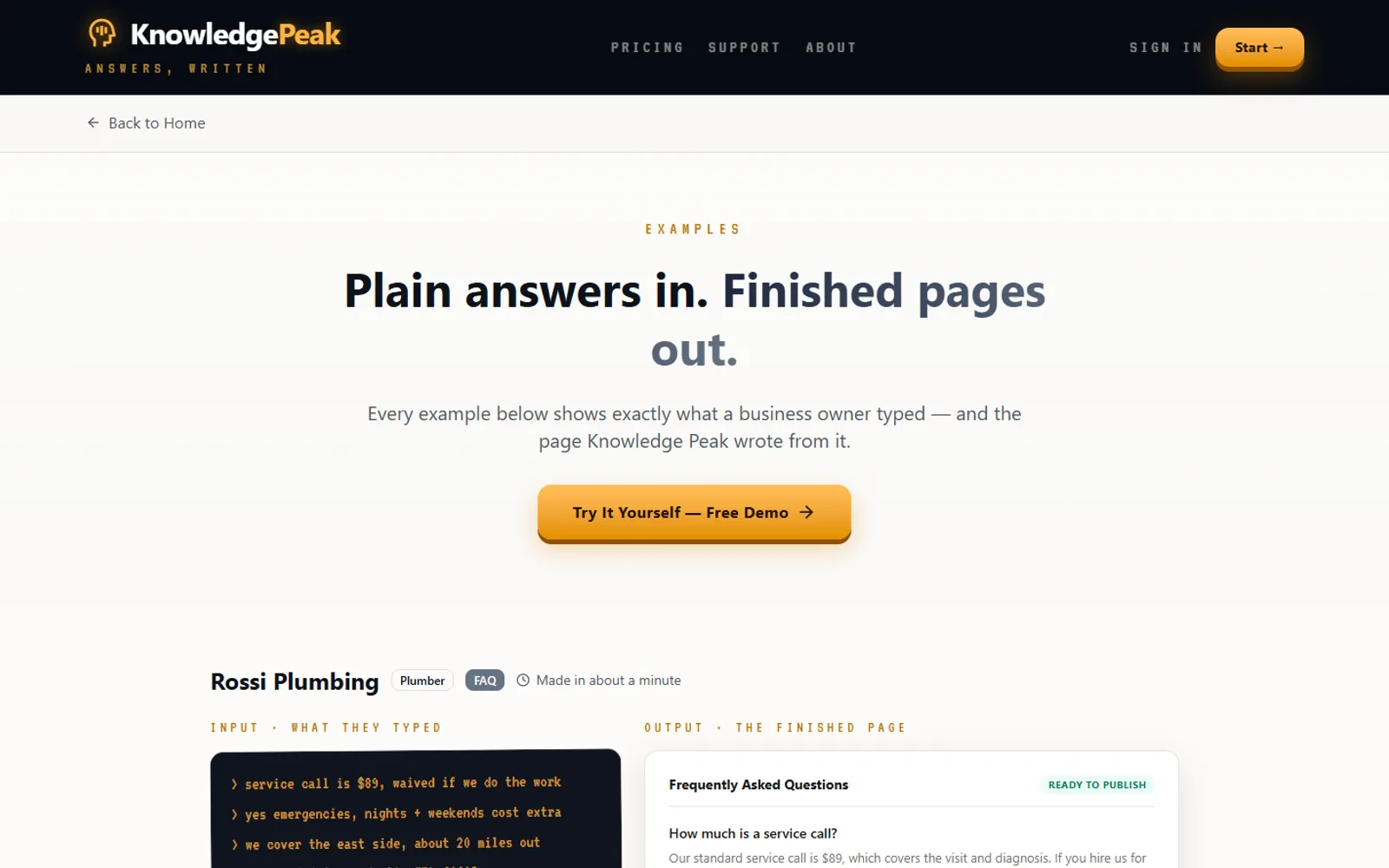
An AI documentation generator that puts enterprise knowledge practice within reach of small teams — guided questionnaires produce structured articles, with provider-agnostic LLM routing and admin-configurable templates.
- Project
- KnowledgePeak.ai
- Role
- Founder & Developer
- Timeline
- 2025–Present

Enterprise knowledge practice, without the enterprise
I spent a decade teaching enterprise support organizations to write good knowledge articles. The methodology works — and it arrives wrapped in KCS training programs, coaching networks and content standards that assume you have staff to dedicate to it.
Small businesses have the identical problem and none of that scaffolding. They need a troubleshooting article, an FAQ, a policy document. What they usually produce is a wall of prose that answers no specific question, because nobody told them the structure is the part that matters.
KnowledgePeak encodes the structure so the user doesn’t have to learn it first.
The questionnaire is the methodology
The obvious version of this product is a text box saying “describe your article.” I built something else, because a blank prompt hands the user responsibility for knowing what good looks like — and that’s the problem they came with.
Each document type has a guided questionnaire derived from the article structures I used in enterprise KCS practice. A troubleshooting article asks about the environment, the symptom, the cause and the resolution as separate inputs. By the time you’ve answered it, the structural work is finished, and the model fills in well-scoped sections instead of inventing a document shape.
It’s the argument I’ve made in writing for years — AI output quality is mostly a knowledge-structure problem — built as a product rather than a conference talk.
Architecture worth noting
Provider-agnostic generation. An LLMService layer sits between the article
generator and the models, currently routing to OpenAI or Grok. Adding or
swapping providers leaves generation logic untouched.
Prompts as data, not code. Templates, system prompts, model configuration and SEO directives live in Postgres, editable through an admin panel, with hardcoded fallbacks that keep generation running if the database is unreachable. Improving output means editing a record rather than shipping a release — the same reasoning behind putting knowledge content in a CMS.
Export that matches reality. Generated articles are editable in a rich-text editor and export to TXT, Markdown, DOCX and PDF, so documentation lands wherever the team already works.
Usage accounting. Generation is metered per user against tracked usage records, with the schema in place for subscription billing.
Where it stands
Generation, editing, export, authentication and admin configuration are live and working. Billing is next: the schema and customer fields are in place, with webhook handling to follow.
More designed & built work
-
USA Archery (proposal & working demo)
USA Archery Platform Modernization
A working modernization of a national governing body's WordPress site — 2,900+ articles migrated to Payload CMS, a rebuilt information architecture, role-based editorial workflow, and a governed AI assistant with citation-backed answers.
-
TerraGreetings
TerraGreetings
A subscription platform for printable outdoor-themed greeting cards — built end to end with auth, payments, an admin CMS, and a browser-side duplex PDF print engine.
-
Shimmer (open source)
Shimmer
Open-source audio restoration and mastering software that removes generation artifacts from AI-produced music. Deterministic DSP, nine detectors on a protected high band, and an audible check on exactly what was removed.
Questions about this work?
Happy to go deeper on any of it — the decisions, the trade-offs, or what I'd do differently.