Article Anatomy
An interactive content standard that maps a knowledge base style guide onto every field of the article template, so hundreds of authors apply the same rules in the tool they write in.
- Project
- Henricks Media
- Role
- Author & Developer
- Timeline
- 2026
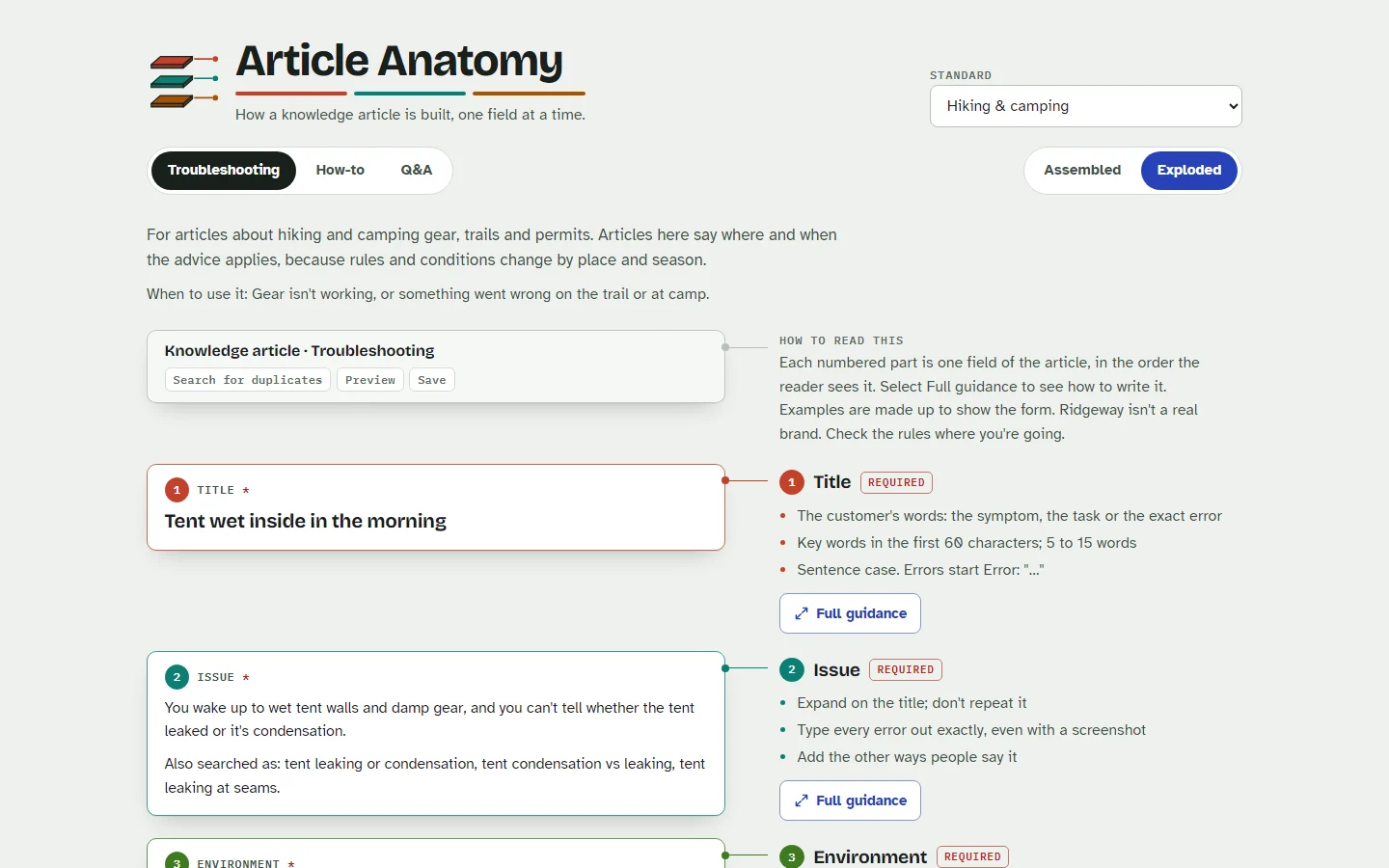
A style guide, mapped to every field
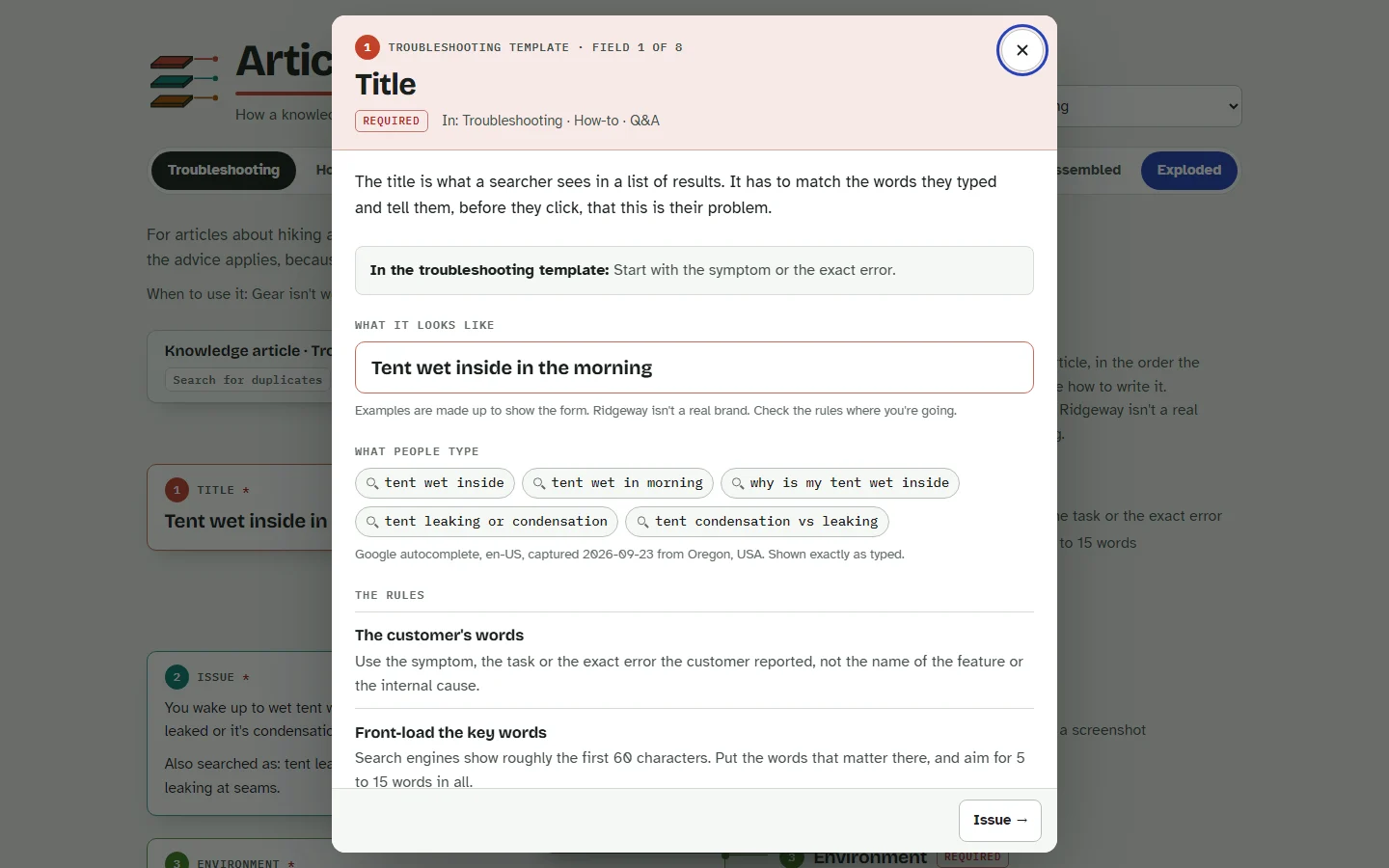
Article Anatomy is an interactive content standard for knowledge articles. It shows the article template the way an author meets it in their authoring tool, one field at a time, with the rules for that field beside it. One click opens the full guidance: the rules, an example filled in, and the reason each rule exists.
One style guide, hundreds of authors
Knowledge-Centered Service (KCS) asks support engineers to capture knowledge in the flow of work: the person solving the case writes the article while they solve it. That puts hundreds of authors in the knowledge base. At Broadcom I coached and enabled 1,500+ publishers and 300+ KCS coaches, and the same gap showed up everywhere.
A style guide is written as a document. An author is looking at a form, in ServiceNow, Salesforce, a CMS or a docs platform, with a cursor in the Environment field. “Write in the customer’s words” and “say what it applies to” are good rules. The author needs to know what they mean in this field, right now. Coaches reviewing the work need the same answer, so the rules are the ones the author saw.
I now work on the floor in Walmart’s online pickup and delivery operation, where the procedure and the customer meet. It’s the moment Article Anatomy is built for.
The template, taken field by field
Each field gets three short lines, a filled-in sample and its full guidance, in the order the template shows them. An exploded view pulls the article apart into its fields, so an author sees the whole shape before writing a word.
Templates differ, and so does the guidance. A troubleshooting article leads with the symptom; a how-to leads with the task. Some industries need fields of their own: automotive articles put safety before the steps, and banking articles carry the time limits a customer can miss.
Rules that apply to every article sit in one place: the required checklist that authors and reusers run, writing style, layout, search synonyms and sensitive data.
One file per standard
Each standard is a single file that builds on a shared base and overrides only what differs: its templates, field names and examples. A team’s standard can match the field names in their own tool, and a new industry is a new file rather than a new tool.
The public version carries a general standard and eight industries, from home appliances to travel. I build client versions for engagements the same way.
Examples in the customer’s words
The example titles come from real searches. I captured Google autocomplete for each industry, and every example article is built on what people type: “tent wet inside”, “car won’t start just clicks”. Each field’s full guidance shows those searches beside the rule, so the first rule of the standard is also the one it demonstrates.
If your authors write against a style guide, I can build a version on your own templates, field names and examples. Tell me about your team.
More enterprise knowledge work
-
Broadcom
Knowledge-Centered Service (KCS) Transformation
Led global KCS and Knowledge Management strategies at Broadcom through major acquisitions, reducing support volume by 20-25% and generating $30M+ in cost savings.
-
Symantec
Elevating Support Through Knowledge Engineering
Advanced enterprise Knowledge Management and KCS at Symantec, driving 20-35% case deflection globally and establishing the foundation for scalable self-service.
-
Henricks Media
Knowledge Management Self-Study Course
A 12-lesson interactive course on KM methodology and AI-first content strategy, built as a self-paced learning experience with knowledge checks and progress tracking.
Questions about this work?
Happy to go deeper on any of it — the decisions, the trade-offs, or what I'd do differently.