TerraGreetings
A subscription platform for printable outdoor-themed greeting cards — built end to end with auth, payments, an admin CMS, and a browser-side duplex PDF print engine.
- Project
- TerraGreetings
- Role
- Founder, Designer & Developer
- Timeline
- 2025–Present
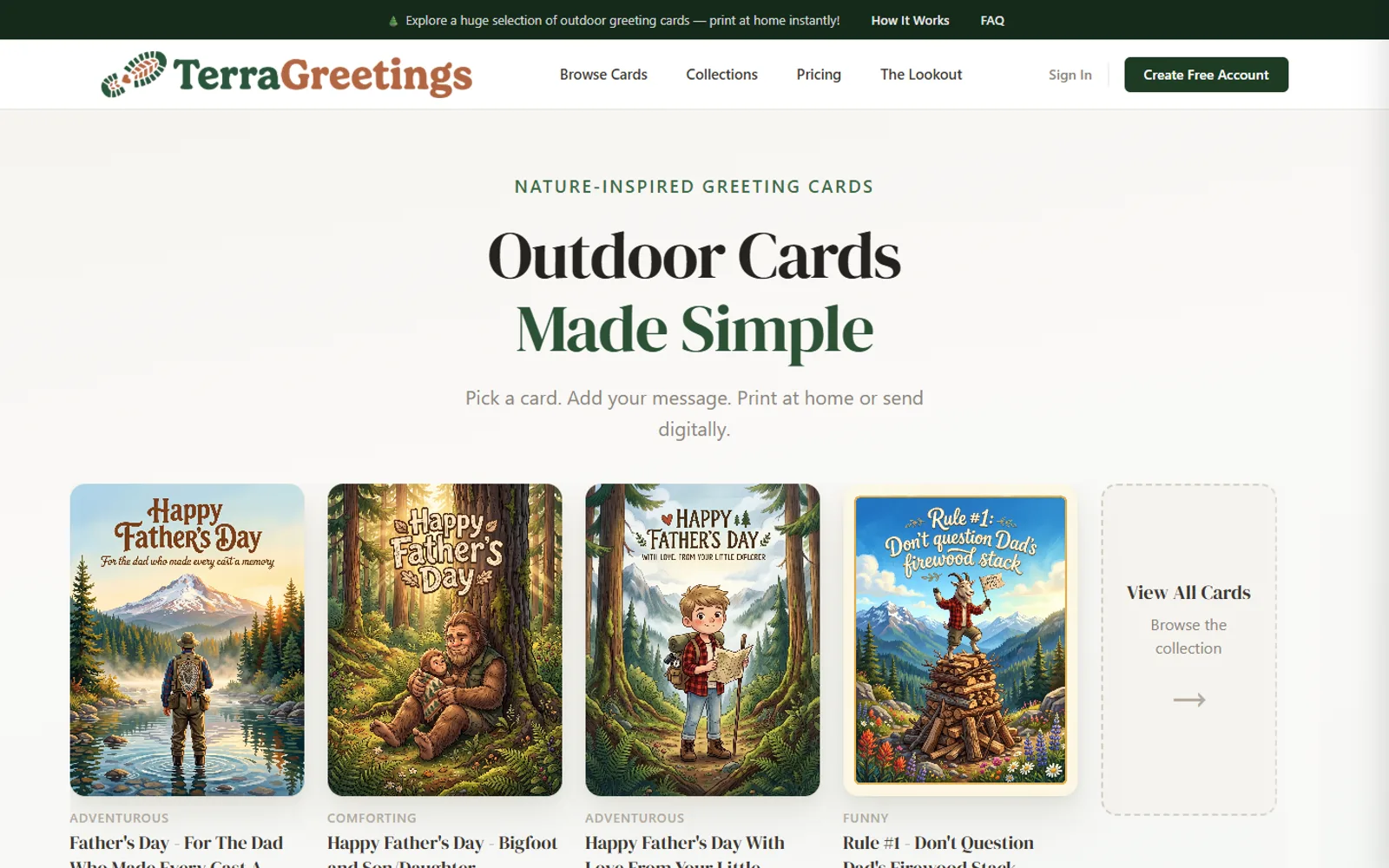
Original outdoor cards, printed at home
Greeting cards hold their value in the message and the moment, while the way you get one has stayed the same for decades: drive to a store, pick through a rack, pay five dollars, mail it.
TerraGreetings offers a different route for people who love the outdoors — original nature artwork, personalized online, printed at home the moment it’s needed. Two problems stood between the idea and the product: building a catalog of hundreds of original cards on a solo budget, and making a home-printed card feel like a real card.
A catalog built from a controlled vocabulary
The artwork is generative, and the structure around it is what makes it work. I built a prompt system with composable dimensions — characters, national parks, moods, occasions — so each card concept assembles from a shared vocabulary.
That does two things. Visual consistency holds across hundreds of cards because every concept draws on the same descriptive language. And the catalog grows by combination: adding one national park or one occasion multiplies against everything already defined, instead of starting a new creative brief.
The prompt builder lives in the admin panel, alongside a standalone Prompt Lab for developing card concepts outside the production system.
Making a printed sheet behave like a card
A card is a single sheet that folds into four panels, with artwork on the right faces and the message reading correctly once folded. That means duplex printing with the back face rotated, fold guides that help without printing over the design, and reliable margins on consumer printers nobody can control.
I generate the print file in the browser with jsPDF, laying out the fold geometry directly. The PDF is produced on the user’s machine from the same asset the preview shows, so what they saw is what prints — and there’s no server-side rendering pipeline to run or pay for. Card art is served in two variants from a CDN: a light one for browsing, full resolution for output. Browsing stays fast and printing stays sharp.
The platform underneath
- Accounts and subscriptions — Clerk for identity, Stripe for checkout, with subscription state resolved against user profiles to gate premium cards
- Data layer — Supabase Postgres covering cards, collections, categories, profiles, subscriptions, shared cards, FAQs and promotions, with role-based access control
- Admin CMS — I run the whole catalog through an admin panel I built: cards, categories, collections, promotions, FAQs, users and the prompt builder
- Sharing — cards can be sent as links as well as printed
- Editorial — an MDX-based content section with 22 posts
Why it belongs here
I designed the concept, built the generative art pipeline, solved the print engineering, implemented authentication and payments, modeled the database, and built the admin tooling that runs it — then shipped it and kept iterating.
The transferable part isn’t the cards. It’s that the instincts behind a working enterprise knowledge base — controlled vocabularies, structured metadata, consistent presentation, and tooling that lets a non-engineer maintain the content — are exactly what made a few hundred greeting cards manageable for one person.
Inside the build
2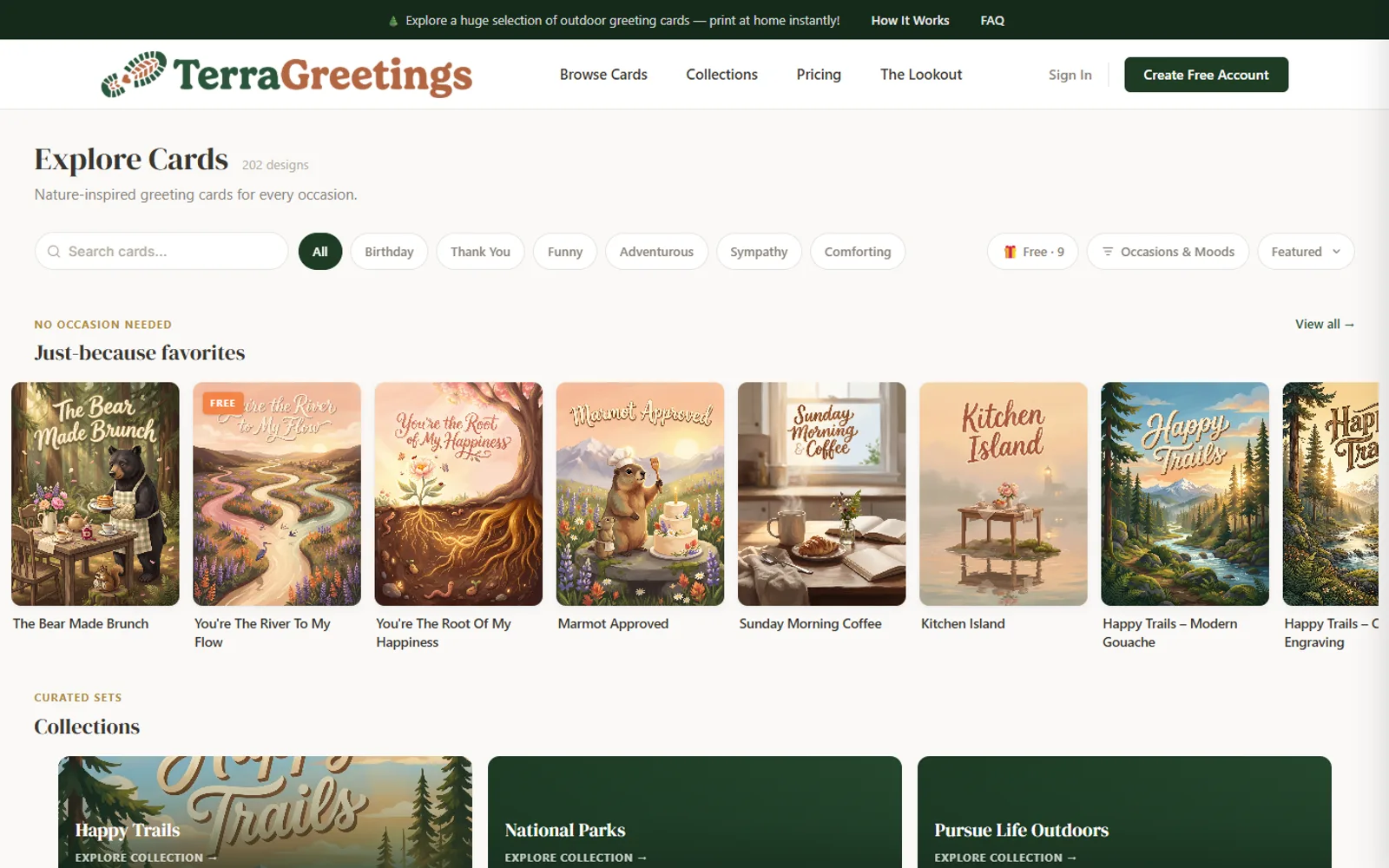
.jpg)
More designed & built work
-
USA Archery (proposal & working demo)
USA Archery Platform Modernization
A working modernization of a national governing body's WordPress site — 2,900+ articles migrated to Payload CMS, a rebuilt information architecture, role-based editorial workflow, and a governed AI assistant with citation-backed answers.
-
KnowledgePeak.ai
KnowledgePeak.ai
An AI documentation generator that puts enterprise knowledge practice within reach of small teams — guided questionnaires produce structured articles, with provider-agnostic LLM routing and admin-configurable templates.
-
Shimmer (open source)
Shimmer
Open-source audio restoration and mastering software that removes generation artifacts from AI-produced music. Deterministic DSP, nine detectors on a protected high band, and an audible check on exactly what was removed.
Questions about this work?
Happy to go deeper on any of it — the decisions, the trade-offs, or what I'd do differently.