Shimmer
Open-source audio restoration and mastering software that removes generation artifacts from AI-produced music. Deterministic DSP, nine detectors on a protected high band, and an audible check on exactly what was removed.
- Project
- Shimmer (open source)
- Role
- Creator & Developer
- Timeline
- 2026
The fizz that AI music leaves behind
Music generated with Suno or Udio carries a characteristic flaw: a thin, fizzy sizzle on the cymbals and a glassy sheen on the vocals, sitting roughly between 5 and 12 kHz. It’s not in the melody or the performance. The model put it there.
Conventional mastering amplifies it. A normal chain reads that noise as part of the music, then compresses and brightens it. The order of operations is the whole insight: clean first, master second.
Shimmer does both, in that order, and shows you exactly what it took out.
Predictable by design
The cleanup path is classical signal processing, chosen so the same settings produce the same result every time. For a tool sitting between someone’s creative work and its release, that repeatability is worth more than a slightly better average result — an artist making a release decision needs to hear the same thing twice. Machine learning handles stem separation, where a learned model genuinely is the right tool, and stays out of the cleanup path.
Treating only what needs treating
The design assumes most of the track is already fine.
The low end passes through untouched. Kick, bass and vocal body bypass the cleaning engine entirely and rejoin at the end.
The center of the mix is protected. Vocals and snare live mostly in the center, so that channel gets gentle treatment while the sides — where most of the generated shimmer sits — get the full pass.
Safety gates ride along, backing off during percussive passages and protecting transients so drums keep their attack.
Then it masters with a single steady loudness move rather than multiband compression, so the dynamics survive the process.
Hearing exactly what was removed
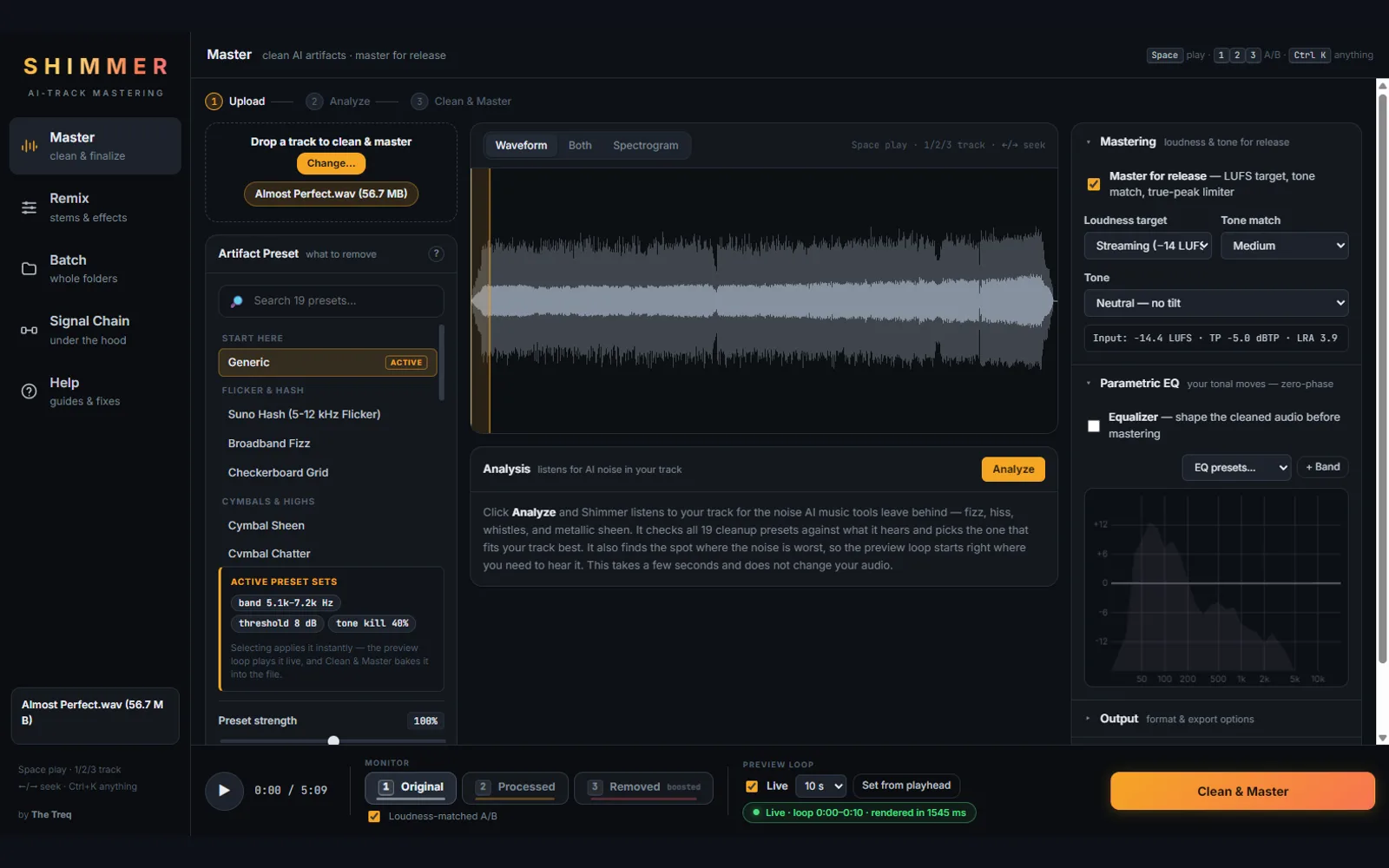
Shimmer plays three versions of the track and switches between them on the number keys while it runs: the original, the processed result, and only what was removed, turned up loud enough to hear clearly.
That third one is the point. The removed track should sound like hiss and fizz. If vocals, snare or melody are audible in it, the tool is cutting too hard and the settings need backing off. The evidence is in the artist’s ears rather than in a claim.
A/B comparison is loudness-matched by default, because volume fools ears and people otherwise pick whichever version is louder.
What else it does
- 19 presets named for what you hear — “glassy cymbals,” “plastic vocals,” “muddy” — rather than for DSP parameters
- Automatic analysis that tests a track against every preset, picks the best fit, explains the choice in plain language, and points to the worst passage
- Live preview that loops a section and re-renders in about a second
- A 12-band EQ with a draggable curve, shaping tone while leaving transients intact
- Stem remixing into vocals, drums, bass and other, with per-stem formant shifting, saturation, doubling and reverb
- Batch processing across a folder, with optional per-track auto-detection
- A signal chain view explaining every stage, in order, in plain language
Built to stay on the artist’s machine
Shimmer runs entirely offline. Unreleased music stays on the computer it was made on, which for this audience is the baseline expectation.
The launcher builds its own isolated Python environment on first run and says up front to expect five to ten minutes. Deleting the folder removes it completely. It ships under AGPL-3.0 with a commercial license available, offers a CLI alongside the web interface, runs its test suite in CI, and documents the macOS and Linux specifics — including CPU-only stem separation on Apple Silicon.
I built it because I make music with these tools and wanted the fizz gone. It’s in this portfolio as evidence of taking an unfamiliar technical domain, learning it well enough to make sound architectural decisions, and shipping a documented, tested, licensed tool other people can run.
More designed & built work
-
USA Archery (proposal & working demo)
USA Archery Platform Modernization
A working modernization of a national governing body's WordPress site — 2,900+ articles migrated to Payload CMS, a rebuilt information architecture, role-based editorial workflow, and a governed AI assistant with citation-backed answers.
-
TerraGreetings
TerraGreetings
A subscription platform for printable outdoor-themed greeting cards — built end to end with auth, payments, an admin CMS, and a browser-side duplex PDF print engine.
-
KnowledgePeak.ai
KnowledgePeak.ai
An AI documentation generator that puts enterprise knowledge practice within reach of small teams — guided questionnaires produce structured articles, with provider-agnostic LLM routing and admin-configurable templates.
Questions about this work?
Happy to go deeper on any of it — the decisions, the trade-offs, or what I'd do differently.