The Treq
An AI-assisted music project with released catalog across streaming platforms — plus the WebGL visualizers, sequencer and video export tools built around it.
- Project
- The Treq
- Role
- Writer, Producer & Creative Director
- Timeline
- 2025–Present
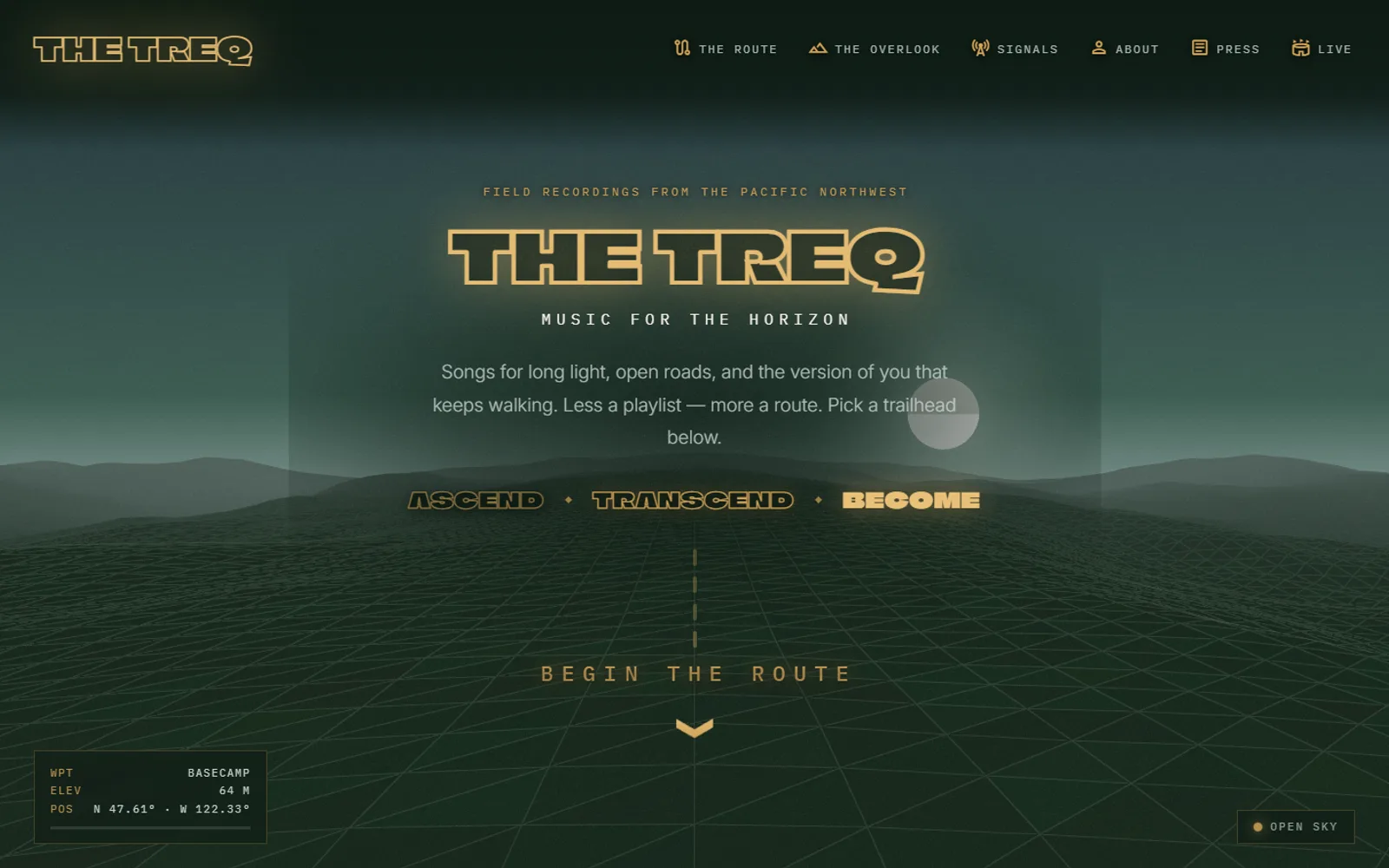
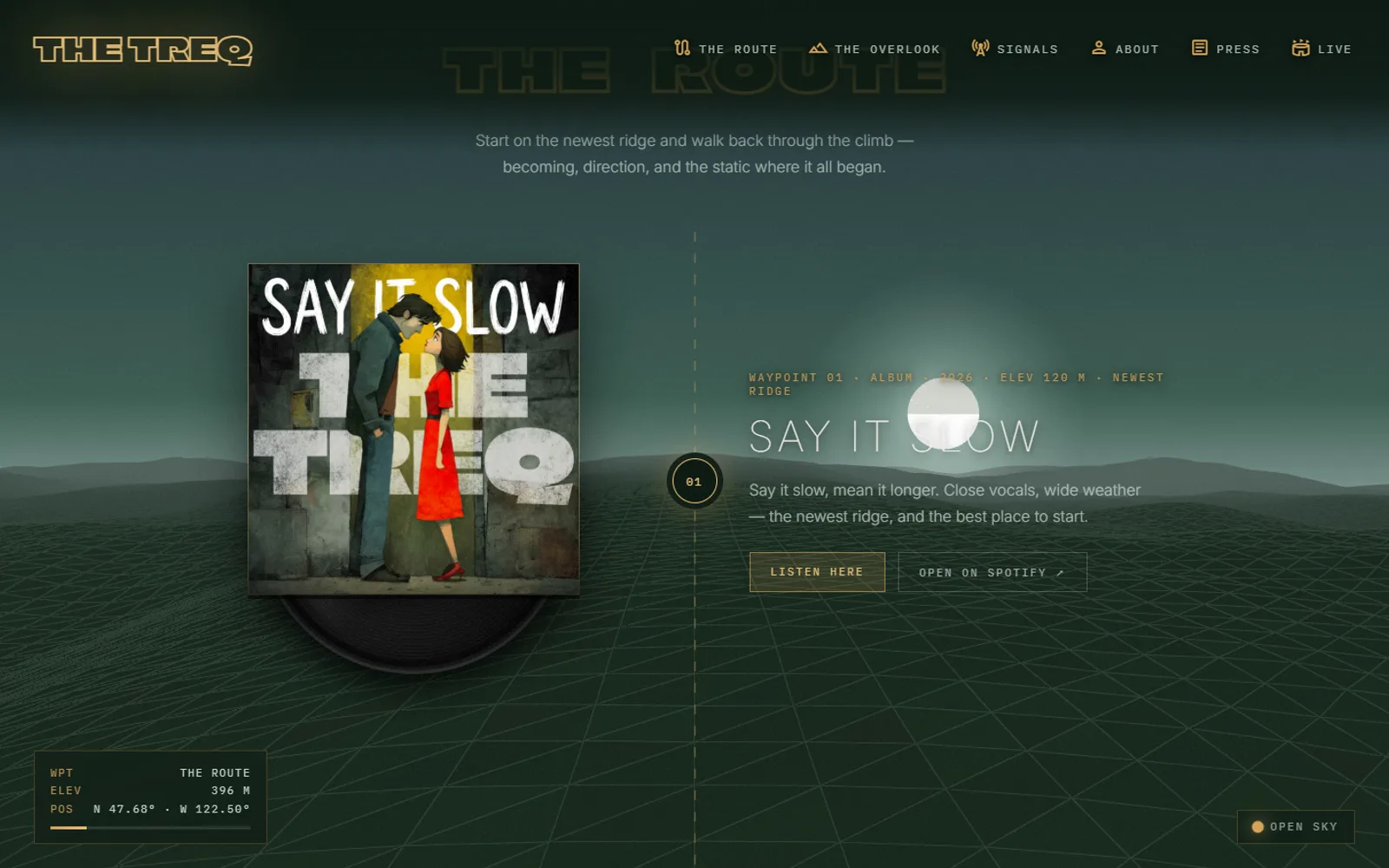
A released catalog, wilderness and coastline
The Treq is a music project distributed across Spotify, Apple Music, YouTube Music and SoundCloud, running from indie-folk through cinematic electronic and EDM, with wilderness and coastline themes throughout.
I write the lyrics, set the sonic direction, choose genre and mood, curate every output and direct the emotional arc of each track. Generative tools produce the soundscapes; the creative decisions are mine.
The tools the music required
Making the tracks kept running into technical limits, and each one turned into something I built.
WideFrequency — a WebGL music visualizer built with Three.js: five audio-reactive scenes, twenty palettes, custom GLSL shaders with bloom and ACES tone mapping, and an OBS capture mode. The audio analysis runs a 4096-point FFT with beat detection across eighteen ISO frequency bands, so the visuals track musical structure rather than overall volume.
Spin — a visualizer built for shareable video. It records the canvas through the MediaRecorder API at fixed output resolutions for TikTok and YouTube, producing clean exports straight from the source.
GrooveCore — a TR-808 style drum machine: a 16-step sequencer on Tone.js with over 100 presets, exporting standard MIDI so patterns carry into a full DAW.
Shimmer — the audio restoration and mastering suite, documented separately in this portfolio. It exists because I needed to clean up my own tracks.
Why it’s in a professional portfolio
It’s an honest picture of how I work. I started making tracks, hit real technical limits, and built tools to get past them: signal processing, real-time graphics, audio analysis, video encoding. Four working tools came out of a creative hobby.
It’s also the clearest statement of where I stand on generative AI. I use it heavily, I direct it deliberately, and I built an entire piece of software to correct what it gets wrong.
More designed & built work
-
USA Archery (proposal & working demo)
USA Archery Platform Modernization
A working modernization of a national governing body's WordPress site — 2,900+ articles migrated to Payload CMS, a rebuilt information architecture, role-based editorial workflow, and a governed AI assistant with citation-backed answers.
-
TerraGreetings
TerraGreetings
A subscription platform for printable outdoor-themed greeting cards — built end to end with auth, payments, an admin CMS, and a browser-side duplex PDF print engine.
-
KnowledgePeak.ai
KnowledgePeak.ai
An AI documentation generator that puts enterprise knowledge practice within reach of small teams — guided questionnaires produce structured articles, with provider-agnostic LLM routing and admin-configurable templates.
Questions about this work?
Happy to go deeper on any of it — the decisions, the trade-offs, or what I'd do differently.