LawnscapeGuru
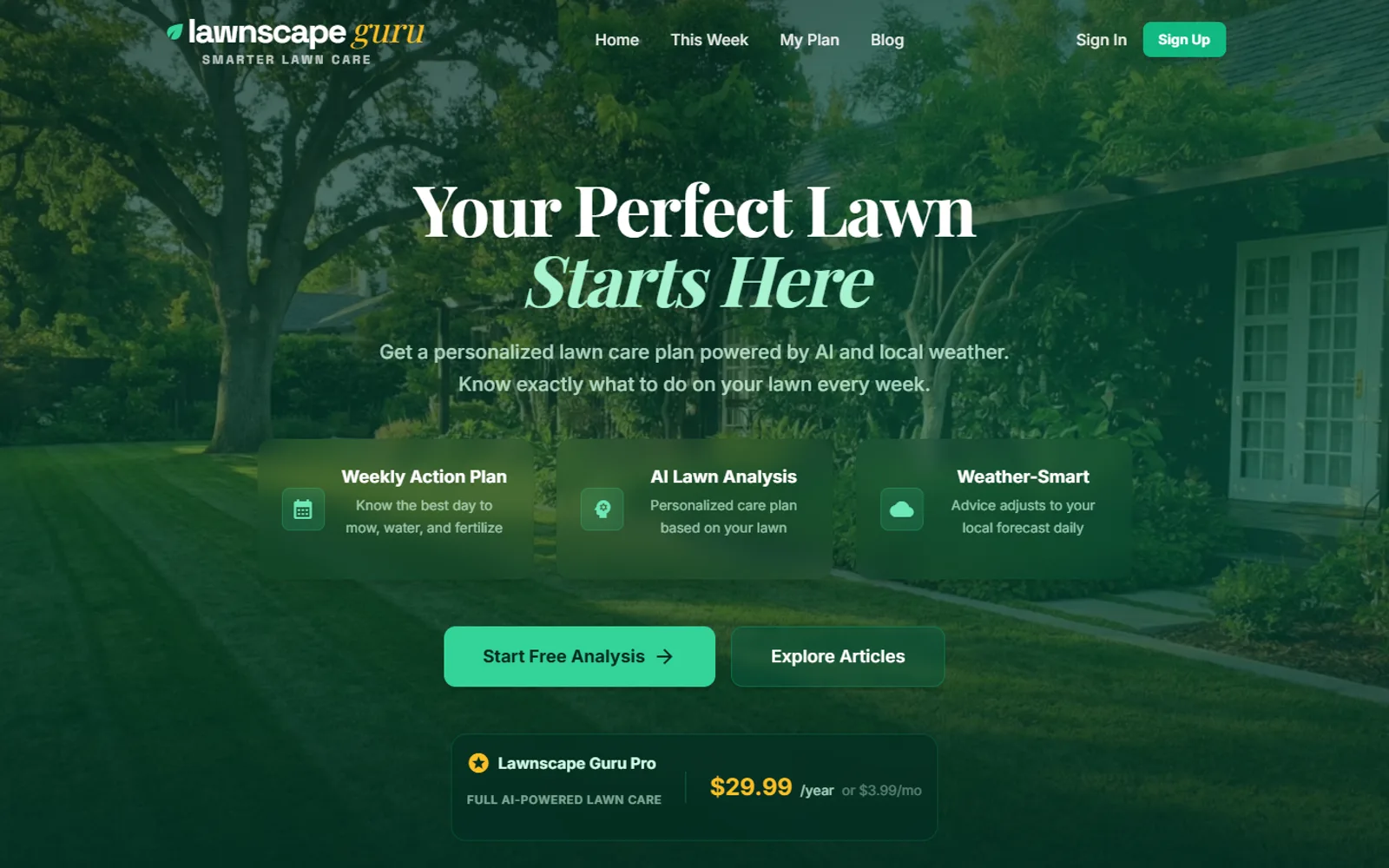
An AI recommendation engine for lawn care: a property questionnaire, hardiness-zone resolution and live forecast data ground the model's weekly guidance, behind auth, subscriptions and a scheduled digest.
- Project
- LawnscapeGuru.com
- Role
- Founder & Developer
- Timeline
- 2025–2026
Lawn advice for this lawn, this week
Good lawn care depends on specifics: your grass type, your soil, your climate zone, and what the weather is doing right now. Most advice online is written for everyone, which means it lands on the wrong week for almost everybody.
LawnscapeGuru asks about the property, resolves the location to a hardiness zone, pulls current and forecast weather, and produces guidance for that lawn on that week.
Weather is what makes the advice specific
“Fertilize in early spring” is a search result. “Hold off on fertilizing — heavy rain arrives in three days and it’ll wash straight off” requires knowing where someone is and what’s about to happen there.
That’s the design: the model reasons over real environmental inputs rather than restating general knowledge. A ZIP-to-hardiness-zone lookup supplies the climate context, and a weekly digest re-evaluates conditions and sends updated guidance — which turns a one-time recommendation into an ongoing service, and is the part that earns a subscription.
Built to run as a business
- Model flexibility — Grok as primary with an optional OpenAI fallback, behind an interface so the model choice stays swappable
- Subscription gating — a free generation allowance before full access, enforced server-side
- Data layer — Postgres via Prisma covering subscriptions, recommendations, saved locations, payments, newsletter subscribers and affiliate products
- API surface — 22 routes spanning recommendations, weather, Stripe webhooks, subscription management, newsletter and the scheduled digest
- Content and email — Contentful for editorial content, Resend for delivery
- Testing — Vitest coverage across the core paths
Where it stands
Live and functional, with the full commercial apparatus running: authentication, payments, metering and scheduled jobs.
It demonstrates taking a personalization idea through the entire stack — external data integration, LLM reasoning over structured inputs, subscription billing and scheduled background work — and getting it deployed.
More designed & built work
-
USA Archery (proposal & working demo)
USA Archery Platform Modernization
A working modernization of a national governing body's WordPress site — 2,900+ articles migrated to Payload CMS, a rebuilt information architecture, role-based editorial workflow, and a governed AI assistant with citation-backed answers.
-
TerraGreetings
TerraGreetings
A subscription platform for printable outdoor-themed greeting cards — built end to end with auth, payments, an admin CMS, and a browser-side duplex PDF print engine.
-
KnowledgePeak.ai
KnowledgePeak.ai
An AI documentation generator that puts enterprise knowledge practice within reach of small teams — guided questionnaires produce structured articles, with provider-agnostic LLM routing and admin-configurable templates.
Questions about this work?
Happy to go deeper on any of it — the decisions, the trade-offs, or what I'd do differently.